Atacama Desert
Country: Chile 🇨🇱
País: Chile 🇨🇱
Страна: Чили 🇨🇱
Video VideoВидео
Overview
San Pedro de Atacama is a practical single base for exploring the Chilean Altiplano.
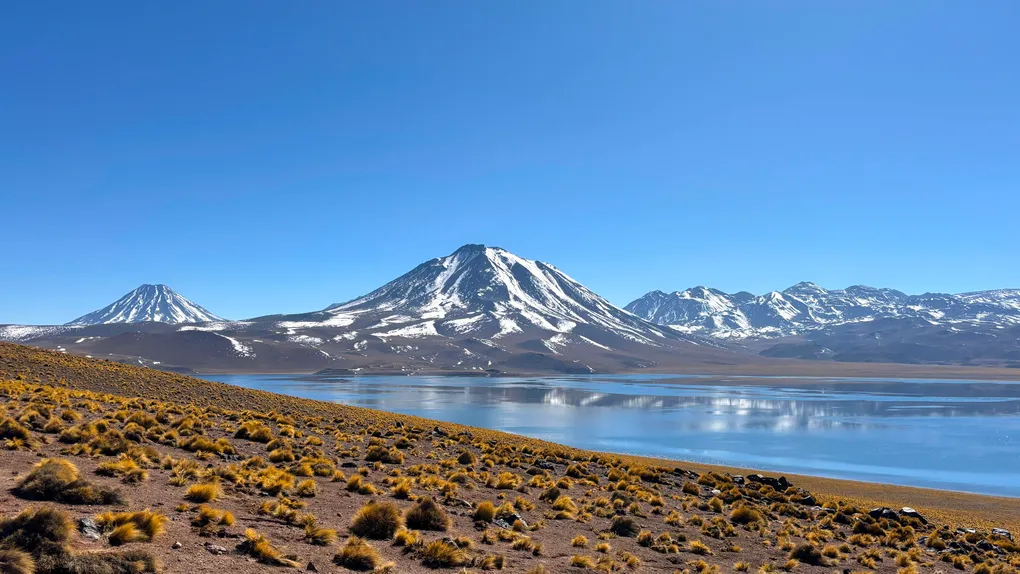
The route is structured by altitude. Volcanoes are one of the defining features of the region. They are visible directly from San Pedro and remain part of the landscape on almost every excursion.
Region: Antofagasta, Northern Chile
Base: San Pedro de Atacama
Overall time: 4–6 days for the core Atacama route; +3–4 days for Uyuni; +1 day for a summit
Main focus: volcano views, salt lagoons, Altiplano landscapes, geysers, desert scenery
Best season: April–June and September–November; winter is dry but cold, while summer can bring highland rain

Arrival & Acclimatization in San Pedro ▾
Altitude:
• San Pedro de Atacama: ~2,400 m
How to arrive:
• Fly to Calama (CJC), usually from Santiago
• Shared airport transfers are the simplest connection to San Pedro
• Calama airport → San Pedro is about 100 km / 1.5 hours
• Public buses also run from Calama city, but require an additional airport-to-city transfer
From Argentina:
• International buses can reach San Pedro from Salta / Jujuy through Paso de Jama
• Check operating days before building the itinerary around this connection
What to do:
• Rest after the transfer
• Walk around the compact town center
• Use the first evening for dinner, tour confirmations, and views toward the Andes
Salt Lagoons & Valle de la Luna ▾
Altitude:
• Around ~2,300–2,600 m
This is the easiest full excursion day and combines two different landscapes without a significant altitude jump.
Morning – Lagunas Escondidas de Baltinache:
• Standard half-day tour, usually returning around midday
• Seven turquoise salt lagoons surrounded by salt crust and open desert
• Floating / swimming is possible only in the lagoon currently designated for bathing and may be suspended for conservation
Alternative salt-lagoon route:
• Laguna Cejar / Laguna Piedra + Ojos del Salar + Laguna Tebinquinche
• Laguna Piedra is the usual floating area
• This route normally operates in the afternoon, so it is better as a separate half-day if you also want Valle de la Luna
Afternoon – Valle de la Luna:
• Standard sunset tour
• Cordillera de la Sal, dunes, folded salt-and-clay formations, and broad desert viewpoints
• Usually runs from mid-afternoon until sunset
• Ckari or another currently open viewpoint is normally used for the final light
Why combine them:
• Salt water and salar landscapes in the morning
• Dry salt-cordillera formations and sunset in the afternoon
• Both stay close to the altitude of San Pedro
If you have more time, split the two tours into separate days instead.
Piedras Rojas & Lagunas Altiplánicas ▾
This is the core landscape excursion of the Chilean Atacama.
Altitude:
• Socaire: ~3,200 m
• Piedras Rojas / Salar de Aguas Calientes: ~4,000 m
• Lagunas Miscanti and Miñiques: ~4,100–4,200 m
Typical full-day tour:
• Laguna Chaxa / Salar de Atacama – salt-flat landscape and flamingos
• Socaire – highland settlement on the route south-east
• Lagunas Miscanti and Miñiques – deep-blue lagoons directly below the namesake volcanoes
• Piedras Rojas / Salar de Aguas Calientes – red volcanic rock, pale salt, turquoise water, and broad high-Andes views
The road continues toward the high Andes close to the Argentine frontier, with volcanoes dominating most of the route.
Why visit:
• Best combination of lagoons, volcanoes, salt flats, wildlife, and high-altitude scenery
• The strongest single landscape day around San Pedro
• Gives a real Altiplano experience while returning to sleep at ~2,400 m
Most tours run for the full day and include breakfast / lunch.
Geysers del Tatio ▾
Altitude:
• ~4,300 m
El Tatio adds a completely new element to the itinerary: a large high-altitude geothermal field.
Typical tour:
• Very early pickup, usually around 04:30–05:00
• Arrival around sunrise
• Steam columns, fumaroles, boiling pools, and geothermal activity
• Breakfast is commonly included
• Short stops around the northern Altiplano may be added on the return
• Back in San Pedro around midday
Why visit:
• One of the world's major geyser fields and the largest geothermal field in the Southern Hemisphere
• Steam is most visible in the cold air around sunrise
• Northern route with a different volcanic landscape from Piedras Rojas
Keep the afternoon free.
Temperatures before sunrise can be well below freezing.
Optional – Astronomical Tour ▾
San Pedro has some of the clearest skies used for astronomy, but this tour should not be fixed to one exact night too far in advance.
Typical format:
• Evening / night departure from San Pedro
• Naked-eye explanation of the sky
• Telescope observations
• Some operators also include astrophotography
Planning:
• Cloud cover can cancel the tour at short notice
• Bright moonlight reduces faint-star and Milky Way visibility
• Some operators suspend standard astronomy tours around the full moon, while others switch to a lunar-focused program
• Avoid placing it before El Tatio or another excursion with a very early pickup
If astronomy is important, try to schedule it before the final night so there is room to rebook after a weather cancellation.
Optional – Puritama Hot Springs ▾
Altitude:
• Around ~3,500 m
Puritama is a half-day thermal stop in a narrow Andean canyon.
What to expect:
• Warm natural pools connected along the canyon
• Developed access and changing facilities
• Morning and afternoon entrance periods depending on the current schedule
Why add it:
• Good recovery option after Piedras Rojas and El Tatio
• Requires little physical effort
• Easy way to add a thermal experience without another long sightseeing route
This is optional rather than a core Atacama landscape.
If you continue to Uyuni, the standard Bolivian route normally includes the Polques thermal pools, so Puritama becomes less important.
Optional – Continue to Uyuni & the Bolivian Altiplano ▾
The natural extension from San Pedro is the Uyuni & Southwest Altiplano itinerary.
Standard formats:
• San Pedro → Uyuni: 3 days one-way
• San Pedro → Uyuni → San Pedro: 4 days return
Why continue:
• More remote and much less developed landscapes
• Laguna Blanca, Laguna Verde, Laguna Colorada, volcano viewpoints, geothermal fields, rock formations, and finally the Salar de Uyuni
• Far less road infrastructure and a stronger expedition feel than the Chilean side
Altitude progression:
• San Pedro: ~2,400 m
• Hito Cajón border: roughly ~4,500–4,600 m
• Highest road / geothermal areas: close to ~4,900 m
• First overnight around Villamar: roughly ~3,900–4,000 m
This extension is substantially more demanding than the Chilean Atacama route.
Use a 4×4 expedition tour rather than attempting it with a normal rental car.
Optional – Cerro Toco or Volcán Láscar ▾
These are high-altitude summit days and belong at the end of the itinerary.
If you return to San Pedro after Uyuni, that is the best point to consider one because acclimatization is usually much stronger.
Otherwise, add a summit only after the regular high-altitude Atacama excursions have gone well.
Cerro Toco:
• Summit: ~5,600 m
• Vehicle approach reaches roughly ~5,000 m
• Around 2–3 hours of ascent in normal conditions
• Non-technical by mountaineering standards, but physically difficult because of altitude
• Wide views over the Chilean and Bolivian Altiplano
Volcán Láscar:
• Summit / crater area: ~5,600 m
• Vehicle approach reaches roughly ~4,900 m
• Longer and steeper ascent than Cerro Toco
• Active volcano with crater and fumarole views when access is permitted
• Check current SERNAGEOMIN volcanic information and operator access before planning it
Both should be done with a mountain guide.
Tours or rental car
The core Chilean Atacama route can be done either with organized tours or with a rented car.
Tours are usually more practical for 1–2 travelers because they:
- handle attraction tickets, check-in times, and local access rules
- provide transport, and often breakfast / lunch / water on remote full-day routes
- remove the need to drive before sunrise or above 4,000 m
- run frequently from San Pedro
A rental car gives more timing flexibility and can become economical for a larger group. The main highways around San Pedro are good, but some attraction approaches are unpaved and high-altitude sites can require advance reservations or specific check-in procedures.
Connections
- San Pedro de Atacama → Core Chile itinerary via Calama and Santiago
- San Pedro de Atacama → Uyuni & Southwest Altiplano by 3-day one-way or 4-day return 4×4 tour
- San Pedro de Atacama → Salta / Jujuy by international bus through Paso de Jama
Useful links
General planning:
- Chile Travel – San Pedro de Atacama:
https://chile.travel/en/destinations/san-pedro-de-atacama/
Transfers and buses:
- Transfer Pampa – Calama airport transfers:
https://www.transferpampa.cl/ - Transvip Calama:
https://www.transvip.cl/localidades/transvip-calama/ - Recorrido – buses to / from San Pedro de Atacama:
https://www.recorrido.cl/es/bus/pasajes-san-pedro-de-atacama
Attractions:
- Valle de la Luna tickets and current access:
https://valledelaluna.com/ - Piedras Rojas / Lagunas Altiplánicas reservations and Socaire check-in:
https://socairechile.cl/shop/ - Geysers del Tatio – current access and tickets:
https://eltatio.net/ - Puritama Hot Springs:
https://termasdepuritama.cl/
Operators and mountain safety:
- Registered tourism services (SERNATUR):
https://serviciosturisticos.sernatur.cl/ - SERNAGEOMIN volcanic alerts:
https://www.sernageomin.cl/alertas-volcanicas/
Best season
April–June:
- Stable weather after the summer highland-rain period
- Good visibility
- Increasingly cold nights toward winter
September–November:
- Dry conditions
- Less severe cold than midwinter
- Good overall balance for the full itinerary
June–August:
- Very dry
- Cold nights and especially cold El Tatio mornings
December–March:
- Warmer
- Highland rain can affect high-altitude roads, views, and tour operation
San Pedro and the main attractions can be visited year-round; the main difference is cold versus highland-rain risk.